Phaco Operation
Phacoemulsification cataract surgery is a procedure in which an ultrasonic device is used to break up and then remove a cloudy lens, or cataract, from the eye to improve vision. The insertion of an intraocular lens (IOL) usually immediately follows phacoemulsification.
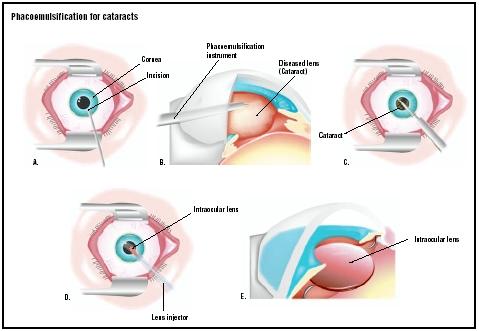
Phacoemulsification, or phaco, as surgeons refer to it, is used to restore vision in patients whose vision has become cloudy from cataracts. In the first stages of a cataract, people may notice only a slight cloudiness as it affects only a small part of the lens, the part of the eye that focuses light on the retina. As the cataract grows, it blocks more light and vision becomes cloudier. As vision worsens, the surgeon will recommend cataract surgery, usually phaco, to restore clear vision. With advancements in cataract surgery such as the IOL patients can sometimes experience dramatic vision improvement.
Cataract Surgery For Pediatricians
Cataract surgery for babies and children will take place in hospital under general anaesthetic, which means your child will be unconscious during the operation. The operation, which usually takes between 1 and 2 hours, will be carried out by an ophthalmologist, a doctor specialising in the treatment of eye conditions.
If the cataracts are present from birth, the operation will be carried out as soon as possible, usually 1 to 2 months after your baby is born. Before the operation, the ophthalmologist will apply drops to the eye to widen (dilate) the pupil.
A very small cut is made in the surface (cornea) at the front of the eye and the cloudy lens is removed. In some cases, a clear plastic lens called an intraocular lens (IOL) or intraocular implant will be inserted during the operation to replace the lens that's removed. This is because the eye can't focus without a lens. But it's more common in babies and young children for external contact lenses or glasses (if both eyes are affected) to be used to compensate for the removal of the lens.
These will be fitted a week or two after the operation. Most ophthalmologists recommend using contact lenses or glasses in children under 12 months old at the time of surgery. This is because there's a higher risk of complications and further surgery being needed in babies who have an IOL inserted.
When the operation is complete, the incision in your child's eye will usually be closed with stitches that gradually dissolve.
Phaco Foldable Lens Operation
Cataract (local term ‘Safed Motia’) is a clouding of the natural lens inside the eye, causing blurred vision. When the cataract has advanced sufficiently to impair daily routine and even glasses do not help much, surgery is the only option. Medicines cannot reverse cataract changes in the eye. In cataract surgery, the lens inside your eye that has become cloudy is removed and replaced with an artificial lens (called an Intra-Ocular Lens or IOL) to restore clear vision. With modern surgical techniques cataract is operated in the immature (partly opaque) stage only, it is not advisable to wait for the cataract to mature (totally opaque) as it can cause complications.
Indian Foldable Lens Operation
Cataract (local term ‘Safed Motia’) is a clouding of the natural lens inside the eye, causing blurred vision. When the cataract has advanced sufficiently to impair daily routine and even glasses do not help much, surgery is the only option. Medicines cannot reverse cataract changes in the eye. In cataract surgery, the lens inside your eye that has become cloudy is removed and replaced with an artificial lens (called an Intra-Ocular Lens or IOL) to restore clear vision. With modern surgical techniques cataract is operated in the immature (partly opaque) stage only, it is not advisable to wait for the cataract to mature (totally opaque) as it can cause complications.
Diabetes Eye Care Clinic
The combined effort of diabetologists and ophthalmologists makes implementation of a screening programme for retinopathy possible in our country. The main problem in diabetes retinopathy is that patients will not have any visual or ocular symptoms until the central seeing area of the retina (macula) is affected or if there is bleeding in the eye. The retinal examination must be done once a year (annually) starting from the time of diagnosis of diabetes for all patients with diabetes.
Newer techniques of screening for retinopathy by using state-of-the-art digital retinal cameras are available. Retinal Colour Photography is used as a screening procedure especially for people. Tele-ophthalmology is a boon for patients in remote areas who don’t have access to ophthalmologists (retina specialists). Telescreening for diabetic retinopathy, which is a cost-effective and reliable method for screening, is done at all our branches where ophthalmologists are not available, using smartphone-based fundus cameras.
Imported Foldable Lens Operation
Cataract (local term ‘Safed Motia’) is a clouding of the natural lens inside the eye, causing blurred vision. When the cataract has advanced sufficiently to impair daily routine and even glasses do not help much, surgery is the only option. Medicines cannot reverse cataract changes in the eye. In cataract surgery, the lens inside your eye that has become cloudy is removed and replaced with an artificial lens (called an Intra-Ocular Lens or IOL) to restore clear vision. With modern surgical techniques cataract is operated in the immature (partly opaque) stage only, it is not advisable to wait for the cataract to mature (totally opaque) as it can cause complications.
Topical Foldable Lens Operation
Cataract surgery is the most commonly performed surgery in ophthalmology. The surgery has gone through major evolutions throughout its history, from ‘couching’ to intracapsular, extracapsular, and nowadays phacoemulsification. The search for a safe and effective technique for anesthesia has also been evolving. Some surgeons have been operating the patient under general anesthesia (G/A). Although it is convenient for the surgeon, it subjects the patient to all the complications of G/A. The retrobulbar block anesthesia method supplemented by facial nerve block (Atkinson, O’Brien, Van Lint, etc) was the gold standard for many decades, but had the disadvantages of being a “blind injection” with the potential of causing perforation, hematomas, or intrathecal/ central nervous system spread. Peribulbar injections avoided the need for facial block, and minimized the incidence of optic nerve damage, but again was a blind procedure with two injections usually needed.
Topical anesthesia has the advantage of avoiding all the problems associated with the above injections. The aim of our study has been to evaluate the efficacy and safety of topical anesthesia in clear corneal phacoemulsification and intraocular lens implantation in the Saudi population in terms of patients’ and surgeon’s satisfaction and rate of complications and rate of significant blepharospasm intraoperatively.
Nasal Treatment And Surgery
Sinuses are cavities inside a person's skull that are situated around the eyes and nose and within the front of the face.
These cavities help to make the skull lighter. They also produce mucus that adds moisture to the nasal passages. The mucus provides a protective layer to help keep out unwanted particles like pollutants, dirt, and infectious organisms.
Sinus surgery is a procedure that aims to open the pathways of the sinuses and clear blockages. This is an option for people with ongoing and recurrent sinus infections, for people with abnormal sinus structure, or abnormal growths in the sinus.
A doctor will often attempt other treatments and procedures before resorting to surgery. If these don't work, surgery may be carried out. Sinus surgery can be done with little discomfort. It is a brief procedure that has few complications.
Nasal And Other Surgeries
The most common type of sinus surgery is endoscopic sinus surgery. However, there are other procedures that may be carried out.
Functional Endoscopic Sinus Surgery (FESS)
FESS is carried out with a tool called an endoscope. This is an illuminated, thin fiber-optic tube. The endoscope is inserted into the nose to reach the openings of the sinuses.
Functional Endoscopic Sinus Surgery (FESS)
FESS is carried out with a tool called an endoscope. This is an illuminated, thin fiber-optic tube. The endoscope is inserted into the nose to reach the openings of the sinuses.
The entire procedure is carried out through the nostrils and leaves little to no scarring. Some swelling may occur, but it will disappear quite quickly.
FESS can be performed frequently. It can also be carried out on an outpatient basis.
Image-guided surgery
Image-guided endoscopic surgery is a newer procedure that may be recommended for severe forms of sinus blockages or after previous sinus surgeries.
In addition to using an endoscope, this type of surgery uses a near-three-dimensional mapping system to show the surgeon the position of the surgical instruments. This is done using CT scans and infrared signals.
Using this guidance, a surgeon can navigate difficult sinus passages and remove tissues and other blockages accurately.
Caldwell-Luc operation
This procedure is less common and more invasive. It tends to be carried out when there is a growth present inside the sinus cavity.
The Caldwell-Luc operation aims to remove growths and improve sinus drainage. It creates a pathway between the nose and the cavity beneath the eye called the maxillary sinus. This window then aids drainage.
The surgeon makes a cut in the upper jaw, above one of the second molar teeth inside the mouth. They then enter the sinus cavity through this cut. This surgery may be performed under local or general anesthetic.
Toric Foldable Lens Operation
Cataract surgery is the most commonly performed surgery in ophthalmology. The surgery has gone through major evolutions throughout its history, from ‘couching’ to intracapsular, extracapsular, and nowadays phacoemulsification. The search for a safe and effective technique for anesthesia has also been evolving. Some surgeons have been operating the patient under general anesthesia (G/A). Although it is convenient for the surgeon, it subjects the patient to all the complications of G/A. The retrobulbar block anesthesia method supplemented by facial nerve block (Atkinson, O’Brien, Van Lint, etc) was the gold standard for many decades, but had the disadvantages of being a “blind injection” with the potential of causing perforation, hematomas, or intrathecal/ central nervous system spread. Peribulbar injections avoided the need for facial block, and minimized the incidence of optic nerve damage, but again was a blind procedure with two injections usually needed.
Topical anesthesia has the advantage of avoiding all the problems associated with the above injections. The aim of our study has been to evaluate the efficacy and safety of topical anesthesia in clear corneal phacoemulsification and intraocular lens implantation in the Saudi population in terms of patients’ and surgeon’s satisfaction and rate of complications and rate of significant blepharospasm intraoperatively.
Multifocal Foldable Lens Operation
Cataract surgery is the most commonly performed surgery in ophthalmology. The surgery has gone through major evolutions throughout its history, from ‘couching’ to intracapsular, extracapsular, and nowadays phacoemulsification. The search for a safe and effective technique for anesthesia has also been evolving. Some surgeons have been operating the patient under general anesthesia (G/A). Although it is convenient for the surgeon, it subjects the patient to all the complications of G/A. The retrobulbar block anesthesia method supplemented by facial nerve block (Atkinson, O’Brien, Van Lint, etc) was the gold standard for many decades, but had the disadvantages of being a “blind injection” with the potential of causing perforation, hematomas, or intrathecal/ central nervous system spread. Peribulbar injections avoided the need for facial block, and minimized the incidence of optic nerve damage, but again was a blind procedure with two injections usually needed.
Topical anesthesia has the advantage of avoiding all the problems associated with the above injections. The aim of our study has been to evaluate the efficacy and safety of topical anesthesia in clear corneal phacoemulsification and intraocular lens implantation in the Saudi population in terms of patients’ and surgeon’s satisfaction and rate of complications and rate of significant blepharospasm intraoperatively.
Phaco Surgery And Lasik-Laser Surgery
Phaco Surgery
Phacoemulsification cataract surgery is a procedure in which an ultrasonic device is used to break up and then remove a cloudy lens, or cataract, from the eye to improve vision. The insertion of an intraocular lens (IOL) usually immediately follows phacoemulsification.
Phacoemulsification, or phaco, as surgeons refer to it, is used to restore vision in patients whose vision has become cloudy from cataracts. In the first stages of a cataract, people may notice only a slight cloudiness as it affects only a small part of the lens, the part of the eye that focuses light on the retina. As the cataract grows, it blocks more light and vision becomes cloudier. As vision worsens, the surgeon will recommend cataract surgery, usually phaco, to restore clear vision. With advancements in cataract surgery such as the IOL patients can sometimes experience dramatic vision improvement.
Lasik-Laser Surgery
LASIK (laser-assisted in situ keratomileusis) is the most commonly performed laser eye surgery to treat myopia (nearsightedness), hyperopia (farsightedness) and astigmatism.
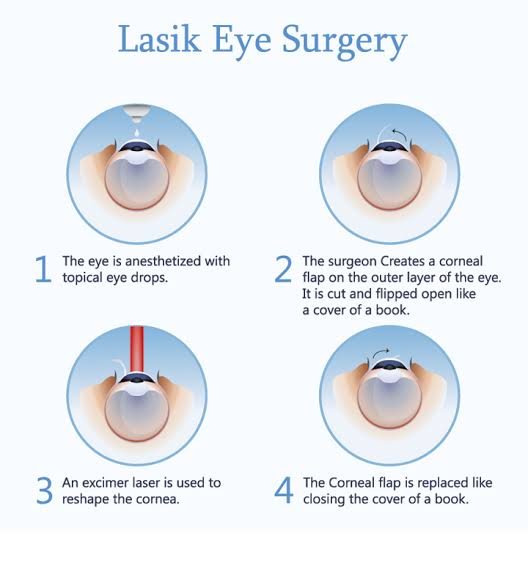
Like other types of laser refractive surgery, the LASIK procedure reshapes the front surface (cornea) of the eye to enable light entering the eye to focus on the retina without glasses or contact lenses.
LASIK typically is pain-free and requires only about 15 minutes to treat both eyes. Vision improvement is immediate and often stabilizes in as little as 24 hours.